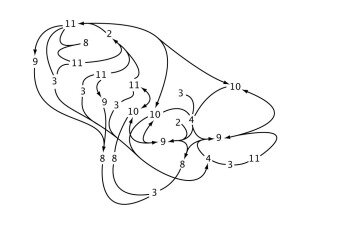
This figure charts paths through successive timespans (interonset intervals) to eliminate simple timespan ratios, not only in relationships between adjacent spans, but in relationships between adjacent compound spans in groups of three or four. This resistance to metric hierarchy, in theory, should apply regardless of emphases formed by accent, compound melody, or other stream-segregating effects.
My writing and scholarship has concentrated on some questions that will seem unrelated: ‘what properties of an irregular rhythm give us confidence in an underlying pulse?’ (Or you might ask ‘what, besides pulse itself, compels us to tap our feet?’) ‘What is a musical “subject”?’ (This is meant not so much in the traditional sense but in the sense of subjectivity, or ‘how and where do we identify with/though—or identify a sense of agency in—music’). Or: ‘what cultural forces are at play in the rise of ‘high-modern’ concepts of musical form (like ‘blue notes’, or phrases and gestures not governed by tonal centers, or Klangfarbenmelodie)?’ These might seem like a laundry-list of unrelated questions, but my scholarship has tried to connect those questions (yes, those three specific questions) intrinsically—connect them on a hunch that their answers are interdepenndent. I also wonder whether the connections between them can support musical practices — sound-making practices (like instrument-playing or singing), discursive practices (like improvisation or concert curation), or listening practices.
Two main interests drive my thinking and writing, each is expressed in one of two large-form essays I’ve made available on this site. The first is a concern about pulse, how we feel it, and how we feel when it’s absent. The second regards the way our ideas about ourselves take form in musical acts, and particularly in acts that determine something about the shape of a “whole” musical expression. Both of these essays hinge on what I hope might be a sensible synthesis of what it means to be radically empirical in contemporary, digital, and popular-cultural discourses.
Pulse is perhaps the simplest kind of musical experience, but aside from attributing it to different kinds of repetition, scholars have little to say about what’s going on when we have strong or weak urges to tap our feet. To study this, I conduct empirical studies of pulse perception: “Perceiving and distinguishing simple timespan ratios without metric reinforcement” (Journal of New Music Research 36/4, December 2007) is my most recent, and most extensive, exploration of this question. I also co-authored (with Ian Saxton) a software environment called Unpulser that helps us to visualize the properties of timespan pairs, and compose with those properties in mind.
I have also been thinking about ideology and musical form in a wider variety of ways. My first try at this was Having a word with you: an exploration of how this piece will be received (1993), a computer program that when evaluated in LISP, produced a specific musical piece, and when read aloud on stage, produced intelligible English prose about that piece, and about musical experience in general.
The most recent expression of this interest has been “Schoenberg’s ambivalent thought: subjectivity in ‘Du lehnest wider eine Silberweide…’”, a study of form and musical development, in Search: Yearbook of Contemporary Music and Culture (New York: Edwin Mellen Press, 2012). In it I combine harmonic analysis, social production theory, and established research in historical musicology, to formulate a challenge to contemporary assumptions about Schoenberg’s early music.

Say’s phoebe (Davenport Beach, California, 9/21)
A number of shorter essays also fall into this category: three in dialogue with the bassist/composer/critic Christopher Williams (who contributed four of his own) to the series “On the Piano Music of Ben Carson”, in TheOpen Space Magazine, Issue 5, December 2005. These have been reshaped into program notes, and can be found in various places around this site. My critical essay about John Adams’ “El Niño”, in Echo 5/1 (2003), also extends this area of interest more generally. I have also written a review essay about musical paradox and illusion: Diana Deutsch’s work on the the psychology (and philosophy) auditory illusions, for the American Journal of Psychology.
***
Where does it all lead? I’m motivated toward all of these questions because thinking about them excites me as a musician and artist. Sometimes the music that results is another experiment, a kind of “found” idea that I test with the help of an intrepid musician. On other occasions—as with my diary-like piano works—what emerges is a personal exploration. And then there’s always the possibility of finding a larger community of listeners, engaging with all of these in more immediate ways, ways to which they attach meaning—whether narrative, axiomatic, or meaning of another kind.